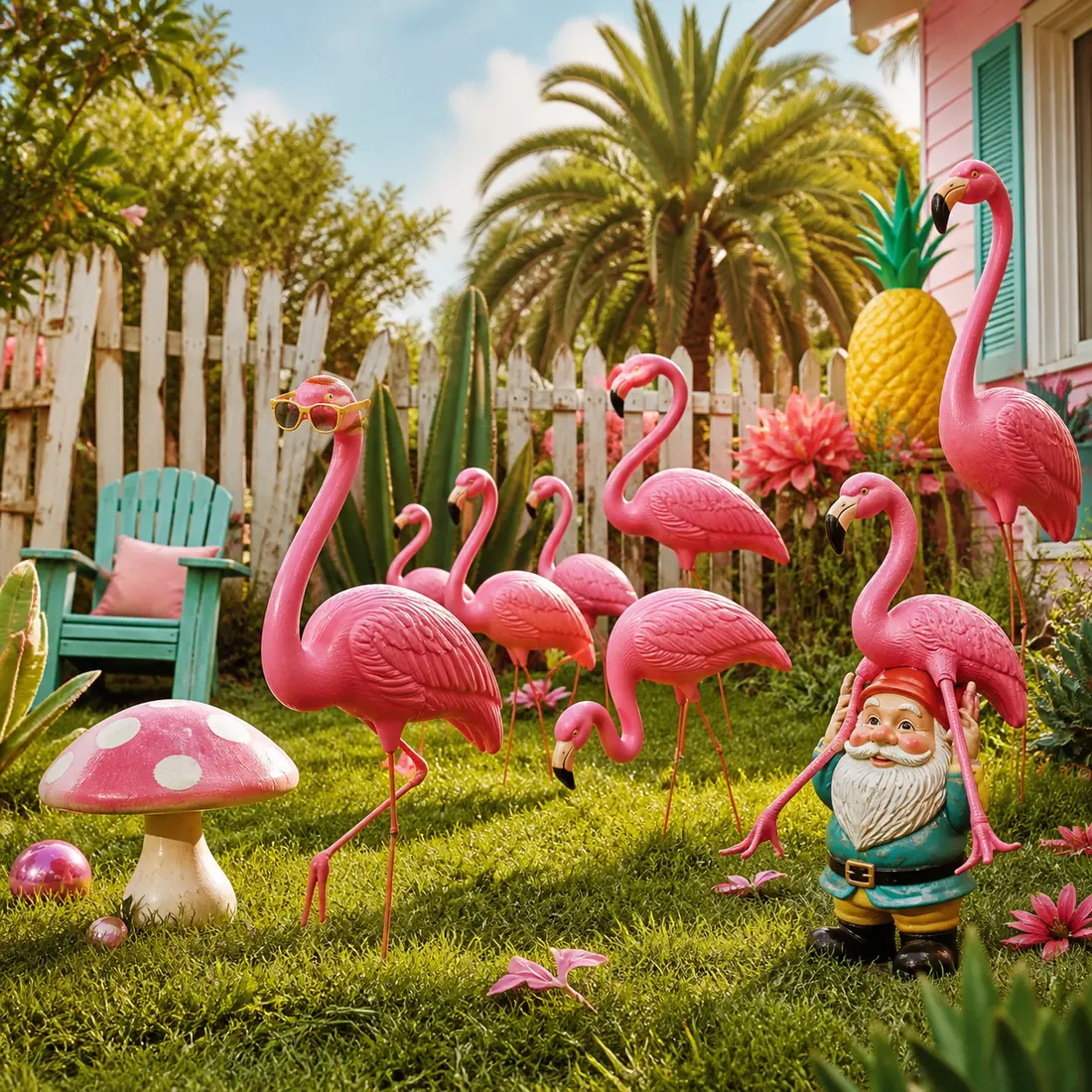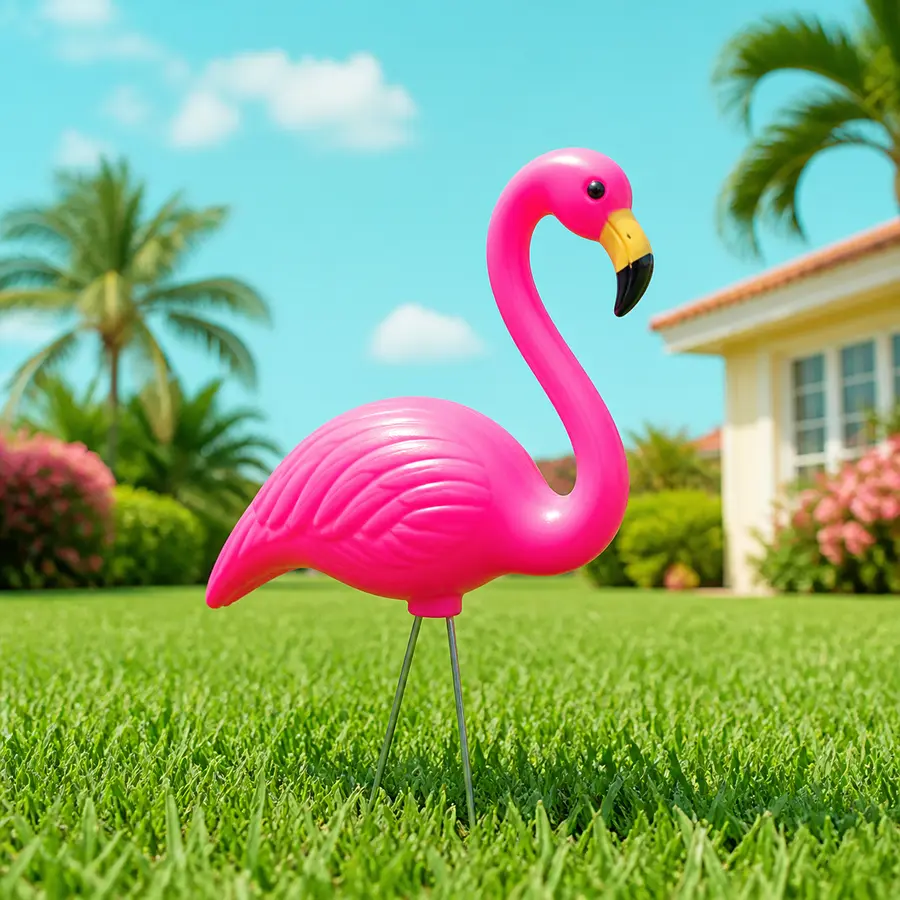
Every plastic flamingo you have ever driven past owes something to one design, sculpted in 1957 in a factory town in central Massachusetts. Not Florida. Not California. Leominster, a place better known for combs and plastics than for tropical birds.
This is the short version of how that bird came to be, why it stuck, and why it keeps coming back every time somebody declares it dead. We are fans, not historians with a museum budget, so we stick to the parts of the story that are well documented and say so when something is lore.
Before the plastic bird: Florida sells the flamingo
Long before anybody stuck one in a lawn, the flamingo was doing marketing work for Florida. Through the early twentieth century the state sold itself to cold northerners with palm trees, sunshine, and pink birds: on postcards, on motel signs, on the names of hotels and racetracks. Hialeah Park, the racetrack near Miami, famously kept a live flock on its infield lake.
So by the 1950s the flamingo already meant something specific to millions of Americans: vacation, warm, somewhere better than here in February. There were flamingo lawn ornaments before 1957, mostly flat cutouts, but they were two-dimensional in every sense.
1957: Don Featherstone sculpts the bird
In 1957 a young art-school graduate named Don Featherstone took a job as a sculptor at Union Products, a plastics company in Leominster that made lawn and garden ornaments. One of his early assignments was a three-dimensional flamingo to replace the flat ones.
The detail everyone loves, and it is well attested: he did not have a flamingo to look at. He worked from photographs, the story goes from National Geographic, and sculpted the bird that would become the template for almost every plastic flamingo since. The birds were sold in pairs, one standing tall and one with its head down, as if feeding. That pairing is still how the classic design is sold today.
Timing did the rest. Postwar America was building suburbs at an astonishing rate, and every new house came with a new, blank, identical front lawn. A cheap, bright, slightly ridiculous plastic bird was an easy way to make yours different from the one next door. Plastics were modern and exciting. Florida was the dream. The flamingo was both.
The 1960s and 70s: from modern to tacky
Popularity is a trap. Once the flamingo was everywhere, tastemakers decided it was too everywhere. By the late sixties and seventies the plastic flamingo had become shorthand for suburban bad taste, the visual punchline for anything cheap, loud, or lower-middle-class.
And that is exactly where it got interesting. Being declared tacky gave the bird a second career as a camp icon: something people put in the yard because it was outrageous, as a wink, a protest against good taste, or a joke the whole street was in on. The flamingo stopped being a status object and became a personality object, which turns out to be a much longer-lasting job. (We wrote a whole piece on that question: are lawn flamingos tacky?)
1979 and after: pranks, flocks and an official city bird
The most famous flamingo stunt happened in 1979, when University of Wisconsin–Madison students planted 1,008 plastic flamingos on Bascom Hill, the big lawn in front of the campus’s main hall. It became campus legend, and in 2009 the city of Madison made the plastic pink flamingo its official city bird.
Around the same time, “flocking” took off: a group plants a flock of flamingos in someone’s yard overnight, as a birthday gag or a charity fundraiser where the homeowner donates to have them removed. It is still a staple of school and charity fundraising, and it is the reason bulk flock packs exist. (More on that in what flamingos in a yard mean.)
The signature, the prize, and the man in matching outfits
In 1987, for the design’s thirtieth anniversary, Union Products added Featherstone’s signature to the mold, a way to tell the original design from the knockoffs that had multiplied for decades. Collectors still look for it.
Featherstone himself leaned all the way in. He kept a flock of his own and, with his wife Nancy, famously wore matching outfits for decades. In 1996 he received an Ig Nobel Prize in Art for the plastic flamingo, which is about as perfect an honor as this object could receive. He died in 2015.
Union Products closed in 2006, which briefly set off headlines about the end of the pink flamingo. The molds found a new owner and the classic design went back into production, which is the most flamingo outcome imaginable: declared dead, back on the lawn within a year or so.
Why the bird is still standing
The plastic flamingo has outlived nearly every other midcentury lawn fad because it can mean almost anything. Florida pride. Retirement. Irony. Sincere love of pink. A birthday. A fundraiser. A neighborhood joke. It is cheap enough to be a whim and iconic enough to be a statement.
If you want a piece of the history, look for the classic upright-and-feeding pair. If you want to make history, buy a flock. Either way, see our guides on staking them so they stay up and picking birds that will not fade, or browse the whole lawn flamingo shelf.
$ Budget-friendly
The Original-Design Pair
The 1957 silhouette, sold as the classic upright-and-feeding pair. Read the listing to see whose version you are getting.
Before you buy: Listings for the classic design vary by maker, so read the seller details and photos closely. If the original shape matters to you, look for mention of the Featherstone design and the signature molded on the body.
Shop this idea on Amazon ↗$ Budget-friendly
The Classic Yard Icon
The everyday classic for a first bird or a pair by the mailbox.
Before you buy: Check the listed height, stake material, and number of birds in the package. Softer ground makes installation easier; dense soil may need a pilot hole.
See it on Amazon ↗$$ Mid-range
Bulk Flock Pack
For recreating Bascom Hill on a smaller, HOA-approved scale. Or not HOA-approved. Your call.
Before you buy: Check the bird count, height, and whether legs ship attached. Bulk packs are often thinner plastic than single classics, which is fine for a weekend prank and less fine for a year in full Florida sun.
Shop this idea on Amazon ↗$ Budget-friendly
Santa Hat Yard Flamingo
The costume tradition, December edition. Removable hats let the bird go back to civilian duty.
Before you buy: See whether the hat and scarf are molded on or removable, how many birds come in the pack, and the stake length. Removable accessories mean the flock can go back to civilian duty in January.
Shop this idea on Amazon ↗Questions people ask
Who invented the plastic pink flamingo?
Don Featherstone, a sculptor at Union Products in Leominster, Massachusetts, designed the three-dimensional plastic lawn flamingo in 1957. Flat flamingo yard cutouts existed before that, but his design became the classic.
How can you tell an original-design Featherstone flamingo?
From 1987 the mold carried Don Featherstone’s signature. Listings for the classic design today vary by seller, so read the product details and photos if the original design matters to you.
Why are plastic flamingos associated with Florida?
Florida spent decades using flamingos in tourism marketing: postcards, motels, hotels, and the famous flock at Hialeah Park. By the time the plastic version arrived in 1957, the bird already meant “Florida vacation” to most Americans.
Is ShopPinkFlamingo affiliated with Union Products or the Featherstone family?
No. We are an independent guide. The history here is just history, and every product link goes to Amazon.
How we pick: we choose products for fit, usefulness, and how much flamingo they deliver, then link to Amazon so you can see current prices, reviews, and availability. We have not hands-on tested every item, and we do not invent prices or reviews. More about us.